
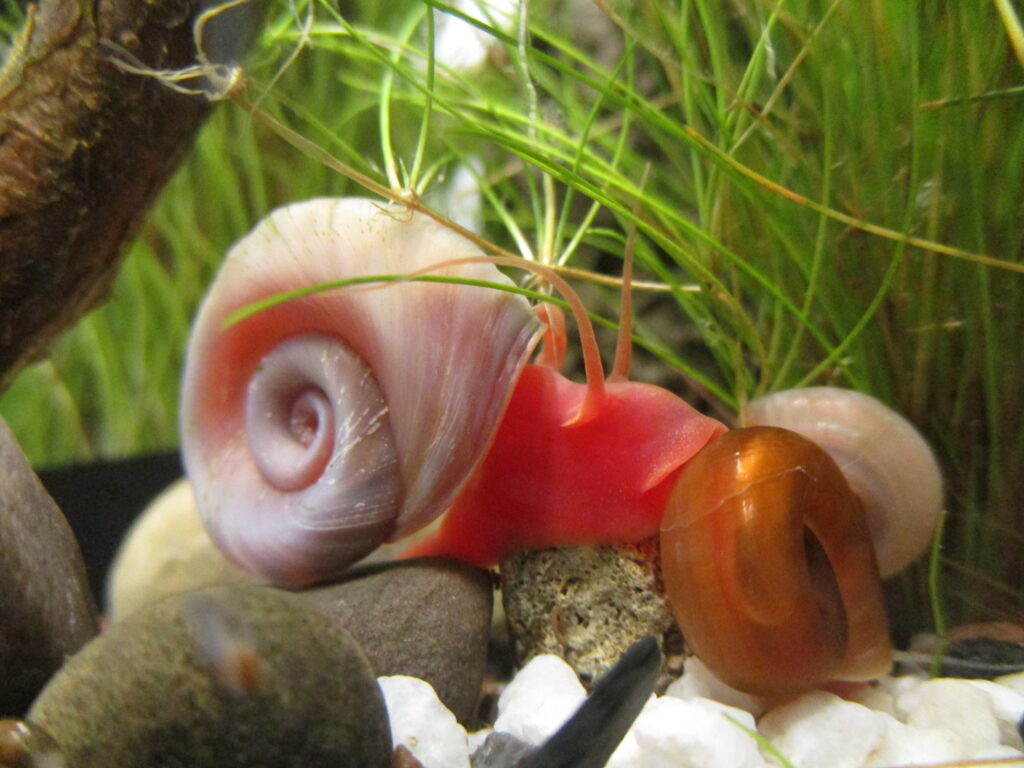
Planorbella duryi — Ramshorn Snail
Planorbella duryi (Wetherby, 1879)
Quick Stats
| Common name | Ramshorn Snail / Seminole Rams-horn |
| Size | Up to ~1″ shell diameter |
| Temperature | 65–82°F |
| pH | 7.0–8.0 (needs calcium for shell) |
| Hardness | Moderately hard to hard (8+ dGH preferred) |
| Minimum tank | Any size |
| Difficulty | Very Easy |
| Diet | Detritivore — algae, decaying plants, uneaten food, biofilm |
| Conservation status | Secure (NatureServe G5); non-native in many regions |
Overview
The Ramshorn Snail is the most divisive invertebrate in the aquarium hobby: one aquarist’s essential cleanup crew is another’s unstoppable pest. Planorbella duryi, the Seminole Rams-horn, is the species behind most of the ramshorn snails in the trade — an air-breathing freshwater pulmonate snail in the family Planorbidae, first described by Wetherby in 1879 as Planorbis duryi.
The common name describes the shell: a flat-coiled spiral that resembles a ram’s horn. Wild-type shells are brown, but captive breeding has produced a remarkable palette — blue, blue leopard, red, orange, pink, green, purple, and brown leopard. These color lines are maintained the same way as cherry shrimp morphs: selective breeding and culling.
Here is the honest assessment: ramshorn snails are extraordinary cleaners and fascinating animals, and they will overpopulate any tank with excess food. Both things are true simultaneously. Whether they are a blessing or a curse depends entirely on feeding discipline.
Natural Habitat and Distribution
Planorbella duryi is endemic to Florida — specifically the freshwater ecosystems of the Florida peninsula, with fossils in the Tamiami formation dating back to the Piacenzian (roughly 3 million years ago). It inhabits streams, ponds, and wetlands, particularly the Everglades.
Through the aquarium trade, it has become one of the most widely distributed freshwater snails on Earth — introduced and established in Hawaii, Great Britain, Ireland, Poland, Hungary, Nigeria, Palestine, Slovakia, India, France, and across the United States. Like the cherry shrimp, it is a living argument against releasing aquarium animals: a Florida endemic now living in thermal springs in Slovakia and brooks in India, carried around the world on aquarium plants.
Care Requirements
Tank setup: They will live in anything that holds water. Provide calcium — this is the one real requirement. In soft, acidic water their shells erode, pit, and eventually fail. Keep pH above 7.0 and GH above 8 dGH. Cuttlebone, crushed coral, or calcium-rich substrates all work.
Water parameters: Extremely tolerant — 65–82°F, pH 7.0–8.0. They breathe air through a lung-like pallial cavity, so they tolerate low-oxygen conditions that would stress fish. They will climb to the waterline to breathe, which is normal behavior.
Diet: Detritivores and among the most effective cleanup crews available. They eat soft algae, biofilm, decaying plant matter, uneaten fish food, dead tankmates, and even fish waste. They do not eat healthy live plants (a common myth — they eat dying tissue, which is why they are often seen on a plant that was already failing). Supplement large populations with blanched vegetables and algae wafers.
Tankmates: Compatible with everything that will not eat them. Avoid: loaches (especially clown and yoyo), puffers, assassin snails, and large cichlids — all enthusiastic snail predators. Note that some aquarists deliberately use snail-eating fish as population control.
Breeding
Ramshorn snails are hermaphrodites — every individual has both male and female reproductive organs, and any two snails can mate. They lay small gelatinous egg clutches on hard surfaces: glass, plants, driftwood, filter intakes. Each clutch contains dozens of eggs; they hatch in 1–3 weeks depending on temperature.
There is no trick to breeding them. The population self-regulates based on food availability: overfeed the tank and you will have hundreds; feed precisely and the population stays modest. This is the entire pest-control strategy — there is no product that works as well as feeding discipline.
Population management options:
- Feed less (the real solution)
- Manual removal
- Snail-eating fish (loaches, puffers) as biological control
- Assassin snails (Anentome helena) for targeted predation
- Never use copper-based snail killers in a tank with shrimp or other invertebrates you want to keep
Conservation Status and Significance
Listed as Secure (G5) by NatureServe within its native Florida range. Globally, it is a successful non-native species — a case study in how the aquarium trade moves organisms. Its significance to the hobby is practical: no cheaper, hardier, or more effective algae-and-detritus cleaner exists. A planted tank with a controlled ramshorn population is a healthier tank.
DSS Breeding Notes
[DSS breeding observations to be added]
Profile researched from Wikipedia, NatureServe, U.S. Fish & Wildlife Service Ecological Risk Screening Summary, and published malacological literature (Wetherby 1879; Pilsbry 1934). Taxonomy follows current Planorbidae classification.
Recommended Gear for Ramshorn Snail
- Red Lava Rock Shrimp Cave — A natural lava-rock cave gives ramshorns shelter and a textured surface for grazing biofilm.
- DSS Nano Spawn Mop — Dense yarn fibers grow biofilm quickly, creating an extra grazing surface snails love in any tank size.