
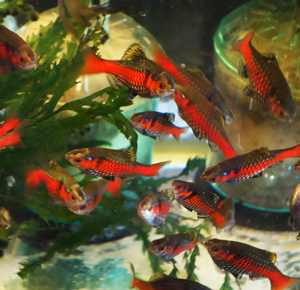
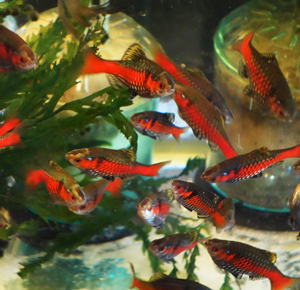
Odessa Barb (Pethia padamya)
Common names: Odessa Barb, Ruby Barb, Scarlet Barb
Quick Stats
| | | |—|—| | Size | Up to 2.5 inches (6 cm) | | Temperature | 70–80°F (best color at 76–78°F) | | pH | 6.5–7.5 | | Tank size | 20 gallons minimum | | Difficulty | Moderate | | Conservation status | Data Deficient (IUCN); known from very few wild locations | | Temperament | Peaceful, schooling community fish |Overview
The Odessa Barb is one of the most intensely colored freshwater fish in the hobby. Males in peak condition display a deep, velvety red lateral stripe unlike anything else in freshwater aquaria — a color so saturated it rivals marine fish. Females are attractive in their own right, with bronze flanks, orange fins, and black speckling.
This species lived in aquarium hobby obscurity for decades before science caught up: it circulated in the trade from the early 1970s (first appearing in Odesa, Ukraine, hence the name) but was not formally described until 2008, when researchers identified wild populations in central Myanmar. The species name padamya is the Burmese word for “ruby.”
The line maintained by Select Aquatics has been selectively bred since 2010 for deeper color, stronger contrast, and consistency — a project aimed at preserving a specially developed strain that has largely disappeared from the commercial hobby.
Natural Habitat and Distribution
Pethia padamya is known from central Myanmar, where it has been recorded from an artificial pond above the Anisakan Falls near Pyin Oo Lwin and from the lower Chindwin River drainage. Its full wild distribution remains poorly understood, which is reflected in its IUCN assessment of Data Deficient.
For years, hobbyists speculated the Odessa Barb might be a man-made hybrid — possibly involving the ticto barb or rosy barb — because no wild specimens had been documented. The 2008 scientific description (Kullander & Britz) confirmed it as a distinct natural species.
Care Requirements
Tank Setup
Odessa Barbs are active, fast swimmers that need room. A 20-gallon tank is the practical minimum, and the difference in male coloration between a cramped 10-gallon and a comfortable 20-gallon is dramatic — stressed males can fade to look nearly identical to females, but recover their full color quickly once conditions improve.
Key setup elements drawn from long-term breeding experience:
– Plants for security. Dense planting — Java fern, Bolbitis, and similar — gives the fish places to retreat. They do best when they can choose between open swimming space and cover.
– Low to moderate lighting. Bright, open tanks wash out their color. A dark background and dark substrate make an enormous difference; males held over white gravel under bright light will look like unhappy, faded fish.
– Oxygenation and water movement. This species needs well-oxygenated water. The aeration from one or two standard 4-inch box filters in a 20-gallon tank is ideal — it does not need to be dramatic, but an airstone or equivalent water movement is important.
– Water changes. Regular water changes noticeably improve coloration. A dirty filter will cause colors to fade.
Water Parameters
– Temperature: 70–80°F. Despite sometimes being described as a cool-water fish, males hold their deepest color at 76–78°F, and breeding is most reliable near 78°F. They will tolerate cooler temperatures, including outdoor ponds, but color and breeding suffer.
– pH: slightly acidic to neutral (6.5–7.5).
– Clean, well-oxygenated water with regular changes.
Diet
Odessa Barbs are unfussy eaters that accept quality flake and pellet foods, supplemented with live and frozen foods such as brine shrimp and bloodworms. Feed once or twice daily. An interesting observation from experienced breeders: their color is most intense when they are slightly hungry, and stays vivid while feeding.
Tankmates
A genuinely peaceful schooling fish — early hobby reports of aggression appear to have been mistaken, a conclusion confirmed by importer conversations. They do well with other peaceful community species, including various swordtails and other barbs. One caution from general hobby experience: like many barbs, they may nip at very long, flowing fins, so avoid pairing them with slow, long-finned tankmates.
Keep them in a group of at least 5; larger groups are better. The sex ratio does not seem to matter — all-male, all-female, or mixed groups all do fine together.
Breeding
Odessa Barbs are adhesive egg scatterers and not difficult to spawn once conditioned — when ready, they spawn consistently and predictably. The challenge is in raising the fry, which are nearly microscopic at hatching (comparable to the smallest rainbowfish or killifish fry).
A proven breeding approach:
1. Condition the breeders with quality foods and clean water. Males will intensify in color dramatically during courtship — they may lose color entirely when first introduced to a breeding tank (a stress response), then color up fully by the second day as chasing begins.
2. Spawn over fine-leaved plants or spawning mops. Like most egg scatterers, the parents will eat their own eggs and those of nearby spawning females, so remove adults after spawning or use a separate breeding tank.
3. First foods are critical: newly hatched fry need infusoria for the first few days, then graduate to vinegar eels or microworms, then to baby brine shrimp. A culture of infusoria can be generated in the breeding tank before introducing the adults by adding dried duckweed and crushed fine-leaved plants.
4. Water quality is the make-or-break factor. Growing fry need 3–4 partial water changes per day during their first month to keep pace with their increasing waste output. By 30 days the fry are large enough to net and must be divided into grow-out tanks — a single spawn can overwhelm a 29-gallon tank.
Males color out fully by about eight months of age.
Conservation Significance
The Odessa Barb’s wild populations are known from only a handful of locations in Myanmar, and its conservation status has not been fully assessed. The selectively bred hobby lines — developed over many years for color and vigor — represent a distinct genetic resource. Maintaining and distributing these lines through hobbyist breeding is a direct contribution to keeping the strain available: as one longtime breeder puts it, anyone who obtains these fish is encouraged to breed them so the specially developed line does not disappear from the hobby.
DSS Breeding Notes
[DSS breeding observations to be added]
—
Care information adapted from Greg Sage / Select Aquatics (selectaquatics.com) with permission. Additional research from FishBase, the IUCN Red List, Wikipedia, and The Aquarium Wiki.
Recommended Gear for Odessa Barbs
- Lifegard 100W Adjustable Quartz Glass Heater — Steady warmth in the 70–80°F range, where their color shows best.
- DSS Standard Spawn Mop — A proven spawning site for these egg scatterers, keeping eggs away from hungry parents.