
Every tropical fishkeeper needs a heater. But walk into the heater aisle (or scroll through listings) and you’re hit with a wall of options: glass tubes, titanium, in-line, substrate cables, preset vs. adjustable, quartz vs. standard glass. This guide breaks down the three main heater types, how they actually perform in a working fish room with 90+ tanks, and which one makes sense for your setup — with specific product recommendations from our own shelves.
The Three Main Types
1. Submersible Heaters
The classic tube that sits inside your tank. The most common heater in the hobby by far, and the backbone of our fish room.
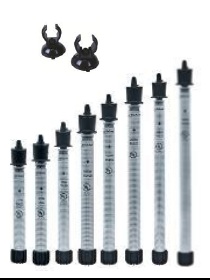
How they work: A heating element sealed in a glass, quartz glass, or shatterproof plastic tube, with a built-in thermostat. You set the temperature, submerge it, and it cycles on and off to maintain it. Modern electronic thermostats are significantly more accurate than the old bimetallic-strip designs.
Quartz glass vs. standard glass: Quartz glass is harder, more thermal-shock resistant, and less prone to cracking than standard glass. If you’re choosing between the two, quartz is worth the small premium — especially in breeding setups where heaters get moved between tanks frequently.
Pros:
- Affordable — quality models start under $25
- Easy to install, adjust, and replace
- Available in every wattage from 25W to 300W+
- Adjustable models let you dial in exact temperatures for breeding triggers
- No dependency on filter type
Cons:
- Visible in the tank (aesthetics matter in display setups)
- Glass models can crack if exposed to air while hot — always unplug before water changes
- Thermostat accuracy varies widely by price tier
- One more piece of equipment to work around during maintenance
Best for: Most hobbyists. Quarantine tanks, breeding setups, grow-out tanks, and any system where reliability and cost-effectiveness matter more than a clean look.
Our pick: The Lifegard Adjustable Quartz Glass Heaters (25W–300W) are what we stock for good reason — quartz glass construction, electronic thermostat control, and adjustable settings. For nano tanks, the 25W Adjustable is ideal; for standard 20–55 gallon setups, the 100W and 200W Adjustable models cover most needs. If you want set-and-forget simplicity, the Pre-Set models (25W–200W) hold a fixed 78°F — great for community tanks where you don’t need to tweak.
2. In-Line Heaters
These sit outside the tank, plumbed into your canister filter’s return line. Water passes through a heating chamber on its way back to the tank.
How they work: A heating chamber spliced into the filter tubing, typically on the outflow side. The thermostat reads water temperature as it flows through and heats accordingly. Because heated water enters through the filter return, distribution tends to be very even.
Pros:
- Completely invisible — nothing in the tank except filter pipes
- Excellent heat distribution through the return flow
- No risk of fish burns, cracked glass, or heater-related tank damage
- Ideal for aquascaped display tanks where equipment ruins the view
Cons:
- Significantly more expensive ($50–$120+)
- Requires a canister filter — incompatible with HOB, sponge, or internal filters
- If your filter stops (clog, power outage, maintenance), heating stops too
- More complex to install, clean, and troubleshoot
- Harder to quickly swap in a fish room with dozens of tanks
Best for: Display and aquascaped tanks already running canister filters, where the clean aesthetic justifies the cost and complexity.
3. Substrate Heating Cables
Low-wattage cables buried under the substrate, originally popularized in the 1990s planted-tank scene.
How they work: Gentle heat from below is supposed to create slow convection currents through the substrate, warming the root zone and promoting nutrient circulation around plant roots.
Pros:
- Completely hidden under substrate
- Very gentle, low-wattage warmth
Cons:
- Negligible impact on actual water column temperature — not a substitute for a real heater
- Expensive for the minimal benefit ($40–$80)
- Must be installed during initial setup (under the substrate)
- The planted-tank science has largely moved on — modern aquasoils and water-column fertilization have made the claimed benefits marginal at best
Best for: Dedicated high-tech planted tank enthusiasts chasing every possible marginal gain. For everyone else, the money is better spent on a quality submersible heater or better lighting.
Head-to-Head Comparison
| Feature | Submersible | In-Line | Substrate Cable |
|---|---|---|---|
| Price range | $15–$40 | $50–$120+ | $40–$80 |
| Visibility in tank | Visible | Hidden | Hidden |
| Works without canister filter | Yes | No | Yes |
| Effectively heats water | Yes | Yes | Minimal |
| Thermostat accuracy | Varies by model (±1–3°F) | Good (±1°F) | N/A |
| Ease of installation | Easy | Moderate | Difficult |
| Ease of replacement | Easy | Moderate | Very difficult |
| Fish room practicality | Excellent | Poor | Poor |
| Best use case | General / breeding / quarantine | Display / aquascaped tanks | Planted tank supplement |
What We Use in the DSS Fish Room (90+ Tanks)
We’ve run all three types. Here’s our honest, experience-based take:
Submersible heaters run our entire fish room. When you’re managing 90+ tanks, the math is simple: cost per tank, ease of replacement, and no dependency on filter type. A failed heater gets swapped in two minutes. We keep spares on the shelf because every heater eventually fails — it’s a matter of when, not if. For breeding work, adjustable models are non-negotiable — temperature manipulation is one of the primary spawning triggers for many species.
In-line heaters have a place, but not in a fish room. They’re excellent for a single showcase display tank. But at 3–4x the cost per tank, plus the canister filter requirement, they don’t scale. We don’t use them in breeding or grow-out systems.
We don’t use substrate cables at all. In our experience, they don’t meaningfully affect water temperature, and the budget is better allocated to quality submersible heaters, better thermometers, or improved lighting.
Sizing: The 5-Watts-Per-Gallon Rule (and When to Break It)
The standard guideline is 5 watts per gallon. A 20-gallon tank gets a 100W heater. That works as a starting point — but real-world conditions matter:
- Cold rooms need more. If your fish room or home drops to 60°F in winter and you’re targeting 78°F, that’s an 18-degree lift. Size up to 7W per gallon or add a second heater.
- Large tanks do better with two smaller heaters than one big one. Two 150W heaters in a 75-gallon tank give you redundancy — if one fails or sticks on, the other provides a safety margin until you catch it. This is standard practice in our fish room for anything over 40 gallons.
- Don’t oversize nano tanks. A 100W heater in a 5-gallon betta tank can cook your fish if the thermostat sticks. Match the heater to the tank: 25W for 5 gallons and under, 50W for 10 gallons.
- Insulation matters. Tanks against exterior walls or near windows lose heat faster. Tanks in a heated fish room with ambient warmth need less wattage.
Quick Sizing Reference
| Tank Size | Standard Room (68–72°F) | Cold Room (below 65°F) |
|---|---|---|
| 5 gal | 25W | 50W |
| 10 gal | 50W | 75–100W |
| 20 gal | 100W | 150W |
| 29–40 gal | 150–200W | 200–250W |
| 55–75 gal | 250–300W (or 2× 150W) | 2× 200W |
| 90+ gal | 2× 200W or 2× 250W | 2× 250W–300W |
Thermostat Accuracy: The Real Difference Between Cheap and Quality
The single biggest difference between a $15 heater and a $35 heater isn’t the heating element — it’s the thermostat. Cheap bimetallic thermostats drift over time. We’ve measured budget heaters running 4°F above their dial setting, which is the difference between thriving fish and chronically stressed fish.
Electronic thermostats (like those in the Lifegard quartz glass line) hold tighter tolerances and drift less over time. That’s the upgrade you’re actually paying for.
Non-negotiable rule: Whatever heater you buy, verify it with a separate thermometer for the first 48 hours. Don’t trust the dial — trust the thermometer. A $5 glass thermometer has saved more fish than any heater upgrade ever will. Check it again seasonally; thermostats drift.
Safety: What Every Fishkeeper Should Know
- Always unplug before water changes. A hot glass heater exposed to air can crack or shatter when cold water hits it. Make it a habit: heater off before hands go in.
- Use a drip loop on the power cord to prevent water from running down into the outlet.
- Replace heaters proactively. Most last 2–4 years. If yours is older than that, replace it before it fails — not after. A stuck-on heater kills faster than a dead one.
- Consider a separate temperature controller for valuable livestock. An external controller (like an Inkbird) with its own probe acts as a safety cutoff if the heater’s internal thermostat fails. Cheap insurance for expensive fish.
- Keep a spare. One backup heater on the shelf is the difference between a minor inconvenience and an emergency.
Our Recommendations
- Best all-around value: Lifegard Adjustable Quartz Glass Heater — quartz glass, electronic thermostat, adjustable. Size at 5W per gallon and verify with a separate thermometer.
- Best for nano tanks: Lifegard 25W Adjustable — appropriately sized so a thermostat failure won’t cook a small tank.
- Best set-and-forget: Lifegard Pre-Set Quartz Glass Heater — fixed 78°F, no dial to bump. Ideal for community tanks.
- Best for large/breeding setups: Two smaller adjustable heaters rather than one large one. Redundancy is the strategy.
- Best for display tanks: In-line heater paired with a canister filter — if the aesthetic justifies the cost.
Questions about sizing a heater for your setup? Contact us — we’re happy to help you get it right.
Learn. Build. Breed. Succeed. — DSS Aquatics