
Our Breeding Project
We maintain multiple Medaka ricefish (Oryzias latipes) lines at DSS Aquatics, including Red Tiger and Platinum Miyuki. We breed medaka because they are one of the most rewarding egg-laying species a fish room can keep: hardy across a wide temperature range, eager spawners, and prolific enough that a single pair can seed an entire grow-out rack. Their eggs are large, visible, and easy to collect, which makes medaka an outstanding teaching species — much of our hands-on spawning and grow-out experience directly supports the educational resources we publish. What makes our project notable is the way we track it: every brood is logged individually in our breeding registry with hatch dates, counts, and line notes, so we can follow line development over generations rather than treating each spawn as an isolated event.
Breeding Methodology
Our medaka breed in dedicated 10- to 20-gallon tanks fitted with mature sponge filters and gentle flow. Each breeding tank gets several spawning mops or clumps of fine-leaved plants such as java moss and guppy grass, where females deposit their eggs. We hold water at a pH of 7.0–7.8 with temperatures between 68 and 78°F; a long photoperiod of 12–14 hours of light at the warm end of that range reliably triggers spawning. Breeder groups are conditioned for one to two weeks on live or frozen foods — daphnia, grindal worms, and quality micro-pellets — before we expect consistent egg production.
We check mops daily, culling infertile or fungused eggs before moving the rest to shallow hatching containers of clean, aged water with a drop of methylene blue. Eggs hatch in roughly 7–14 days depending on temperature. Newly hatched fry are tiny, so first foods are infusoria and powdered fry food for the first several days, followed by newly hatched baby brine shrimp once they can take it. We grade grow-out tanks by size every week or two, because larger fry will outcompete — and occasionally eat — their smaller siblings. Selected fish are held back as future breeders to refine color and finnage in each line.
Current Status
As of our September 19, 2026 fish-room census, we are growing out 27 Red Tiger Medaka fry and 13 Platinum Miyuki fry, all between approximately one and four weeks old. Multiple adult breeder lines are maintained in spawning condition, and new eggs are collected weekly. Every brood is entered in the DSS Aquatics Master Breeding Registry with hatch dates and counts, and standout individuals are photographed for future species profiles and breeding journals.
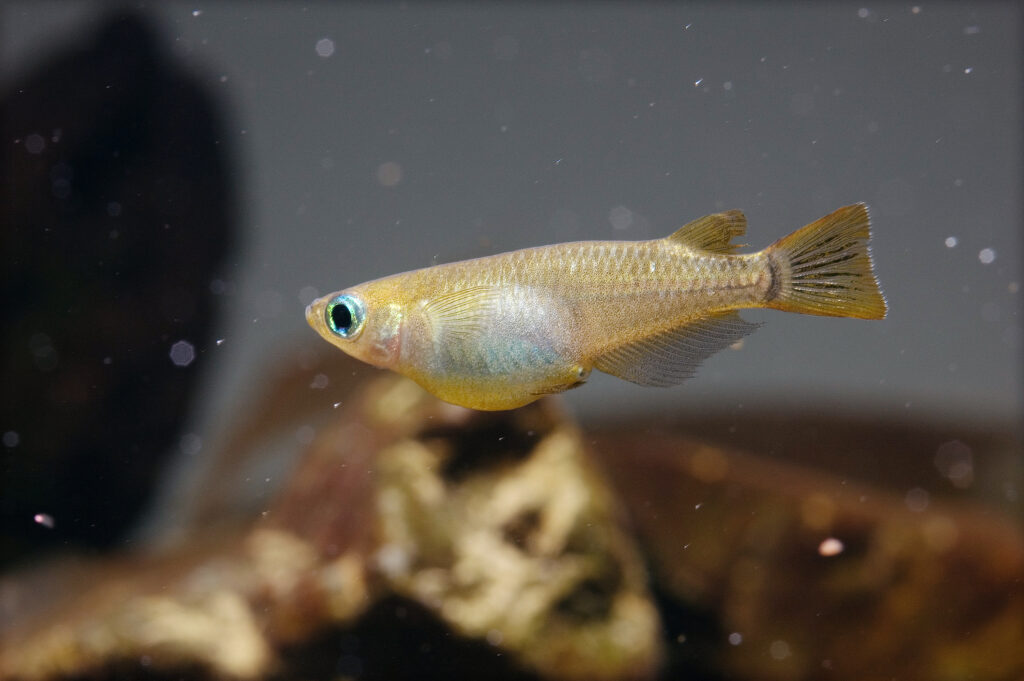
Photo by Seotaro, licensed under CC BY-SA 3.0, via Wikimedia Commons.